In August 1643, a city of barely 5,000 inhabitants held firm against the full might of the Royalist army. Gloucester's 26-day resistance against King Charles I became a turning point in the English Civil War, earning the city its reputation as the fortress that saved Parliament.
The Royalist Onslaught
King Charles I arrived at Gloucester on 10 August 1643 with an army of 6,000 infantry and 2,500 cavalry. By the end of the siege, Royalist forces would swell to over 15,000 troops. The king established his headquarters at Matson House, two miles south-east of the city, and placed overall command of the siege with Lord Forth.
The city's defences appeared inadequate for such an assault. Gloucester's medieval walls, running from the South Gate to the East Gate, were high but too thin to withstand 17th-century artillery. The garrison numbered no more than 1,500 men: two half-strength regiments of roughly 600 soldiers each, supported by local trained bands, 100 dragoons, and a single cavalry troop. Worse still, the city lacked sufficient gunpowder for a prolonged defence.
Yet Gloucester possessed natural advantages. The River Severn protected the western approach, while marshy ground lay to the north and north-east. The River Twyver guarded the eastern flank. These waterways funnelled any attacking force towards the south and east walls, where the defenders had thrown up earthworks and flooded surrounding fields.
A Disastrous Beginning
Royalist siege works began on 11 August, with trenches dug to within 130 yards of the walls. By 12 August, the besiegers had established a fortified position on Gaudy Green, mounting two 24-pounder cannon, the largest of eight Royalist guns, alongside a 12-pounder.
The bombardment commenced at 11:00 on 13 August. It ended almost immediately. One of the two Royalist mortars, reputedly the largest in the country, exploded on its first firing. By 14 August, Royalist guns had fallen silent. They had run out of ammunition.
Massey's Aggressive Defence
Lieutenant-Colonel Edward Massey, governor of Gloucester since early 1643, refused to cower behind his walls. On 16 August, he led the largest Parliamentarian raid: 400 men sallied from the north gate and claimed 100 Royalist casualties at a cost of only six defenders.
Such spoiling attacks became Massey's signature. A two-pronged raid on 21 August marked the last large-scale Parliamentarian operation, but smaller harassing actions continued throughout the siege. While Royalist miners from the Forest of Dean attempted to tunnel beneath the walls, Massey's men disrupted their work. An attempt to fill the moat with fascines was beaten back by musket fire; the miners deserted. Welsh miners arrived on 29 August to renew the effort, but Parliamentarian countermining, abandoned only when springs caused flooding on 28 August, had bought crucial time.
By 1 September, Massey had fortified Friars Orchard with earthworks and artillery. On 3 September, the defenders placed a saker cannon in a secret gun port in the east wall, forcing Royalist guns to target it directly.
The Royalists anticipated their mine would reach the east gate on 4 September. The defenders were down to their last barrels of gunpowder. The city could not have held another day.
Relief and Retreat
On 3 September, the Earl of Essex's relief army reached Oddington, two miles east of Stow-on-the-Wold. On 4 September, Prince Rupert's cavalry clashed with Essex's advance elements and was forced to retreat. On 5 September, Essex descended Prestbury Hill to Cheltenham. The Royalists lifted the siege and withdrew to Matson.
The casualties reflected the siege's one-sided nature. Royalist losses totalled 120 confirmed dead, with conservative estimates suggesting 1,200 killed, wounded, or sick, plus 800 desertions. The Parliamentarian garrison lost only 30 to 50 men.
Why Gloucester Mattered
Gloucester's survival had strategic consequences far beyond the city's walls. Possession of Gloucester, combined with Bristol, threatened both Oxford, the Royalist capital, and access to Welsh recruiting grounds. Had the city fallen, Royalist garrisons at Worcester and Shrewsbury could have been supplied from Bristol. Gloucestershire would have faced punitive taxation. Welsh manpower could have been deployed elsewhere.
Instead, the siege forced King Charles into the open field, where he failed to defeat Essex's army at the First Battle of Newbury on 20 September 1643. Parliament retained the initiative. Gloucester remained a Parliamentarian stronghold for the remainder of the war.
The Legacy in Stone and Memory
King Charles II ordered Gloucester's walls demolished after the Restoration in 1660. Modern Gloucester now covers most Civil War sites. Yet traces remain.
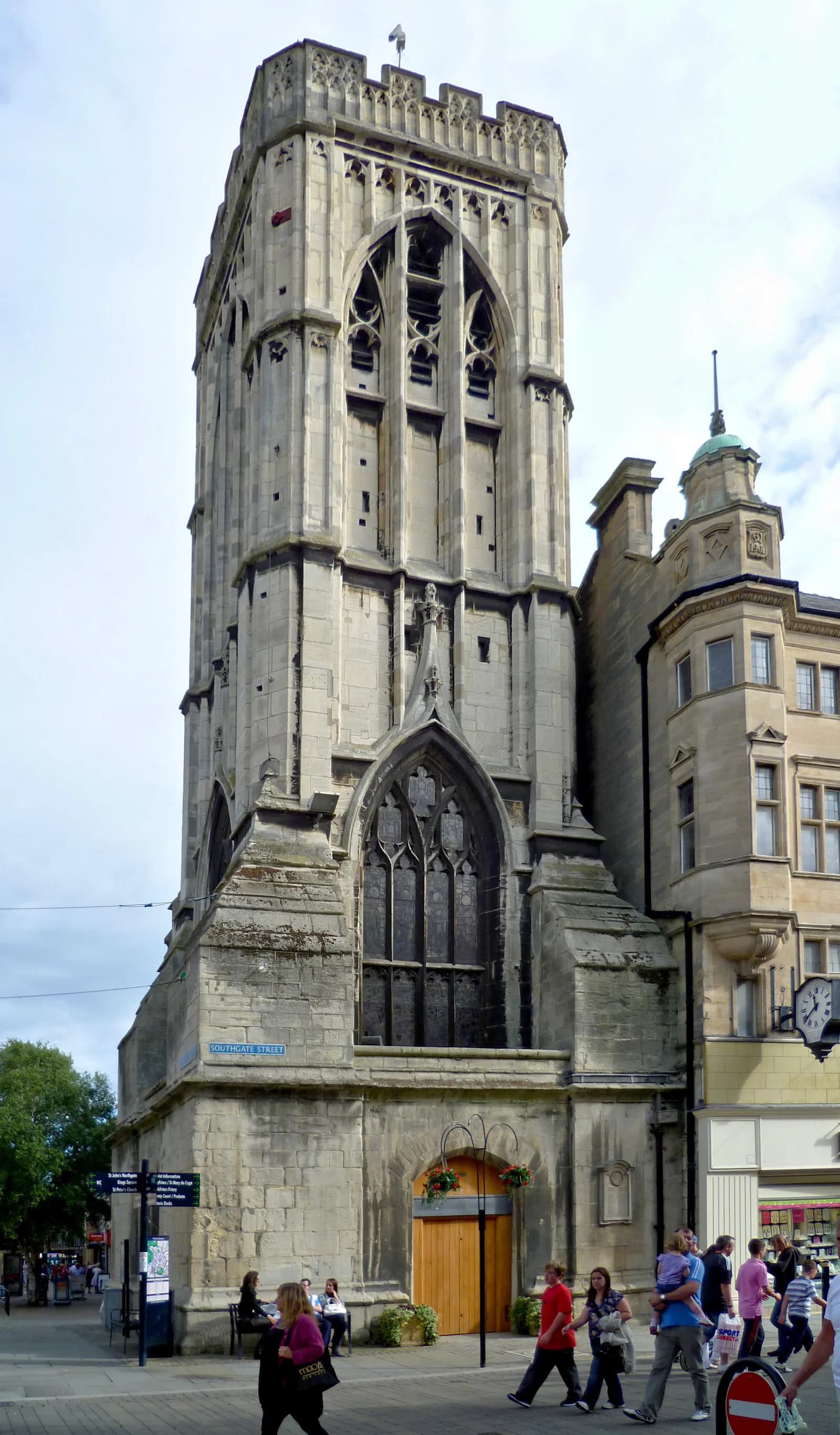
St Michael's Tower, the 1465 structure at the crossroads of Northgate, Eastgate, Southgate, and Westgate Streets, stands as a reminder of the city's medieval fortifications. The Eastgate Chamber on Eastgate Street contains remains of the Roman and medieval East Gate. The city's motto, Fides Invicta Triumphat ("unconquered faith triumphs"), directly references the 1643 siege.
Matson House, where Charles I directed operations, still stands two miles south-east of the city centre. Llanthony Secunda Priory to the south served as Lord Forth's fortified camp. The cathedral and St Oswald's Priory formed part of the inner defensive circuit.
Gloucester Day, celebrated annually on 5 September, marks the lifting of the siege. The tradition died out in the 19th century but was revived in 2009. Each year, the city remembers the 26 days when its outnumbered, outgunned defenders defied a king and changed the course of English history.