Robert Raikes (1735–1811) was a Gloucester newspaper proprietor whose idea for educating working children on their only day off grew into a movement that transformed British childhood. His Sunday schools, which began in a modest Gloucester home in 1780, became the forerunners of England's state education system and reached millions of children across the nation.
From Prison Reform to Prevention
Raikes first became interested in social reform through his work on prison conditions in Gloucester gaol. He observed that many of the city's poorest children were drawn into vice and criminality, and he concluded that prevention would be more effective than cure. The children of factory workers and labourers worked six days a week, sometimes for more than thirteen hours a day, with no access to formal education.
Sunday was the only day these children were free. In July 1780, Raikes founded his first Sunday school in the home of a Mrs Meredith in Gloucester. It was initially for boys from the city's slums, though girls were admitted soon afterwards.
How the Sunday Schools Worked
The original curriculum was straightforward: children learned to read using the Bible as their textbook, then progressed to the catechism. Raikes outlined the typical day in an account published in his newspaper in 1783: "The children were to come after ten in the morning, and stay till twelve; they were then to go home and return at one; and after reading a lesson, they were to be conducted to Church. After Church, they were to be employed in repeating the catechism till after five, and then dismissed."
The instruction was provided by lay people rather than clergy. At Mrs Meredith's home, older boys coached younger ones under her supervision. Raikes's wife, Anne, served plum cake to the children when they gathered in the garden of the family home.
A Movement Takes Root
Raikes used his position as proprietor of the Gloucester Journal to publicise the schools and bore most of the cost during the early years. An account published in the paper on 3 November 1783 caught the attention of national publications, and word spread through the Gentleman's Magazine and later the Arminian Magazine in 1784.
Growth was rapid. By 1788, an estimated 300,000 children were attending Sunday schools across Britain. By 1831, that figure had reached 1.25 million, approximately 25 per cent of the population. Adam Smith, the economist, gave the movement his strongest commendation: "No plan has promised to effect a change of manners with equal ease and simplicity since the days of the Apostles."
Controversy and Opposition
The movement faced significant opposition. Critics derisively called them "Raikes' Ragged Schools." Some church authorities argued that teaching on Sundays desecrated the Sabbath, whilst others feared it would weaken home-based religious instruction. The "Sabbatarian disputes" of the 1790s led many Sunday schools to cease teaching writing, limiting their curriculum to reading and religious instruction.
Raikes's Gloucester Legacy
Gloucester retains tangible connections to Raikes across three historic sites. Ladybellegate House at 20 Longsmith Street, where he was born and lived from 1757 to 1772, is a Grade I listed building dating from approximately 1704. Robert Raikes' House at 36–38 Southgate Street, a Grade II* listed timber-framed building constructed in 1560, became his printing office in 1758 and his family home from 1772. It now operates as the Robert Raikes Inn.
Raikes was baptised at St Mary de Crypt Church on 24 September 1736, having been educated at The Crypt School nearby. He was buried beneath the South Chapel of St Mary de Crypt Church following his death on 5 April 1811, aged 74.
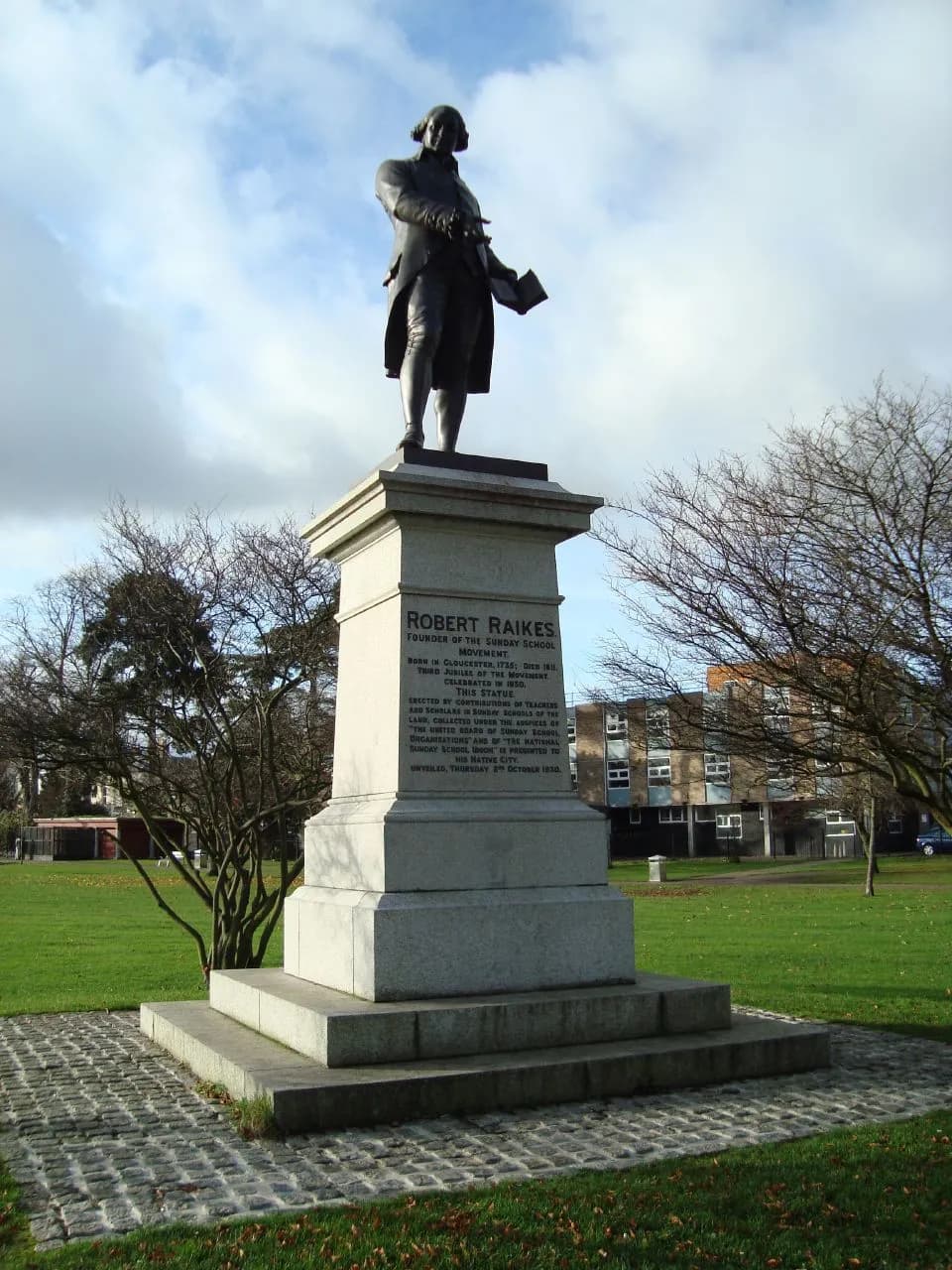
In 1930, to mark the 150th anniversary of the first Sunday school, Gloucester received a replica of Thomas Brock's London statue of Raikes. The bronze depicts him seated, with an open book, surrounded by children.
Lasting Influence
The Sunday School Society was founded in London in 1785, building on Raikes's model. By 1910, more than 5.5 million children attended Sunday schools throughout the UK. The movement is widely regarded as the precursor to England's compulsory state education system, which began with the Education Act of 1870, nearly a century after Raikes's first experiment in Gloucester.